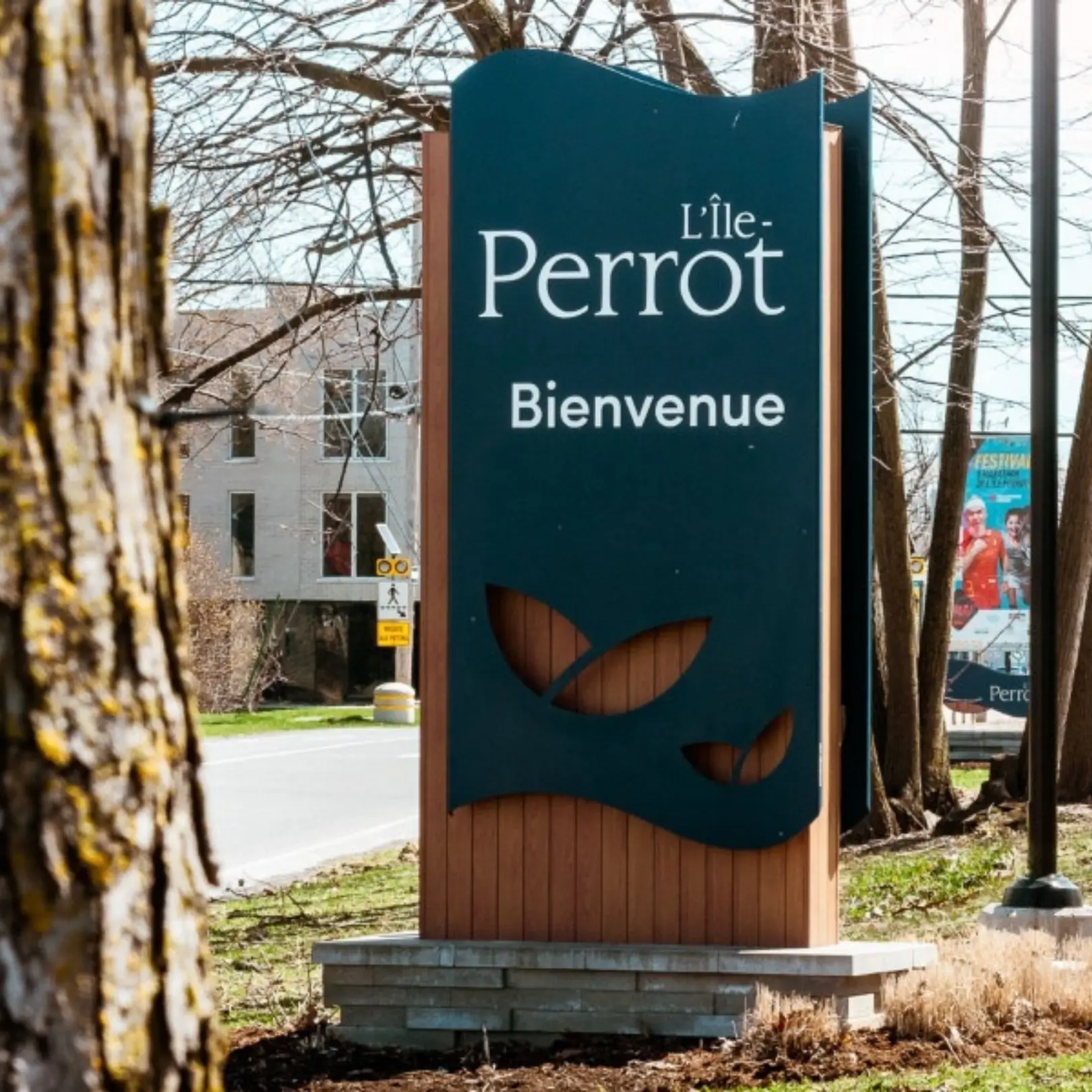
The off-island trade-off has always been framed around what you give up — urban access, proximity, convenience. That framing is wrong. Here’s what you actually get when you cross the bridge.
Water. Everywhere. Île-Perrot is an actual island, ringed by water. The St. Lawrence, the Ottawa River branch, and the Lac des Deux-Montagnes all border it. That means waterfront access is a real, accessible lifestyle element here — not an exclusive luxury reserved for the top 5% of buyers. Homes with river or lake views, properties with docks, and lots within walking distance of waterfront parks are all available at prices that would be laughable in Beaconsfield or Pointe-Claire.
Quiet. This is harder to quantify but impossible to dismiss. Île-Perrot has approximately 12,000 residents in the municipality of L’Île-Perrot proper (with nearby Notre-Dame-de-l’Île-Perrot, Terrasse-Vaudreuil, and Pincourt adding another 25,000+). It is, by design and by geography, a quieter, slower-paced community. The kind of place where traffic is light on weekday mornings and kids play outdoors without supervision. That character is not incidental — it’s a feature, and buyers who have left the density and noise of urban neighbourhoods consistently say it’s what they value most about the move.
A growing community, not a static one. Île-Perrot and the surrounding Île Perrot peninsula have been growing steadily. The municipalities in the area — L’Île-Perrot, Notre-Dame-de-l’Île-Perrot, Terrasse-Vaudreuil, Pincourt — collectively house nearly 40,000 people, and that number has been increasing. New development is happening, new commercial amenities are following, and the community infrastructure is improving. Buyers who moved here ten years ago have watched their communities get better while their equity appreciated. That trajectory continues.
The 514 area code. Île Perrot is the only off-island suburban area of Montreal that uses the 514 area code — the city’s own designation. Every other off-island suburb is a 450. This is a quirky but meaningful detail: Île Perrot has always been culturally tied to Montreal’s West Island in a way that other off-island suburbs are not.
Île-Perrot Neighborhoods & Areas: Where to Buy
The Île Perrot peninsula (note: “Île Perrot” refers to the island as a whole, home to four municipalities; “L’Île-Perrot” is the specific municipality on the western side) has distinct pockets, each with a different character and price profile.
L’Île-Perrot Municipality
The western municipality is the most rurally flavoured pocket on the island — larger lots, quieter streets, and the most direct waterfront access to the Ottawa River branch and the Lac des Deux-Montagnes. Housing stock here tends toward postwar bungalows, split-levels, and older custom homes, many on lots that would be impossible to find at any price on Montreal Island. This is the destination for buyers who want maximum land and maximum quiet. The commute via Highway 20 is straightforward (30–35 minutes to downtown in off-peak), and the Île-Perrot commuter rail station on the Exo Vaudreuil-Hudson line provides a car-free alternative.
Notre-Dame-de-l’Île-Perrot
On the eastern side of the island, Notre-Dame-de-l’Île-Perrot is the more established and somewhat more suburban of the two primary residential municipalities. It has a town centre feel, more commercial services, and a slightly higher density than L’Île-Perrot proper. Families appreciate the proximity to schools and services here. Housing ranges from modest townhomes and condos to larger single-family detached properties. The community feel is strong — this is a municipality where the local arena and recreation centre are genuinely central to community life.
Terrasse-Vaudreuil
Just off the eastern tip of the island, Terrasse-Vaudreuil is technically on the mainland portion of the peninsula but is functionally considered part of the Île Perrot community. It’s small and residential, primarily single-family detached housing, with a quiet character similar to L’Île-Perrot municipality. Buyers looking for detached homes on the eastern approach to the island often consider Terrasse-Vaudreuil as part of the same search.
Pincourt
On the northeast portion of the island, Pincourt is the peninsula’s largest municipality and the most suburban in character. It has its own mayor, council, and community services, and it functions as a more conventional suburb — commercial corridors, schools, parks, and primarily single-family housing. Historical median pricing in Pincourt has been among the lowest in the broader West Island region, making it a strong entry-level option. Buyers who want the island lifestyle with the most conventional suburban infrastructure tend to land in Pincourt.
Waterfront Properties: The Island’s Premium Tier
Properties with direct water frontage — on the Ottawa River branch, the St. Lawrence, or the Lac des Deux-Montagnes — represent the island’s premium tier. Unlike the rest of the greater Montreal area where waterfront commands staggering premiums, Île Perrot waterfront homes still trade at prices that feel grounded. A home with private dock access and river views in the $700,000–$1,000,000 range is achievable here. The same property in Dorval or Beaconsfield would easily exceed $1.5M–$2M.
Île-Perrot Real Estate Market: Prices, Trends & What Drives Demand
Current Market Overview (2025–2026)
Royal LePage data for L’Île-Perrot shows an average MLS price of approximately $534,250, with approximately 45% of properties being single-family detached homes and the remainder a mix of small apartment buildings and townhouses. REALTOR.ca shows prices starting at $314,000, with active listings typically concentrated in the $400,000–$700,000 range for most buyers.
Price ranges by property type:
| Property Type |
Approximate Price Range |
| Single-family detached (starter) |
$400,000 – $600,000 |
| Single-family detached (established) |
$600,000 – $850,000 |
| Waterfront / river access |
$700,000 – $1,200,000+ |
| Townhome |
$300,000 – $500,000 |
| Condo / apartment |
$250,000 – $420,000 |
These figures represent a significant discount versus comparable properties on the Island of Montreal — typically 20–35% less for equivalent square footage and lot size. For buyers who can accommodate a 30–40 minute commute (by car or by commuter rail), the financial advantage is substantial.
Market Dynamics
Post-COVID growth has held. Île Perrot was one of the areas that saw dramatic price acceleration in 2020–2021 as remote work created demand for more space outside the city. According to Montreal Gazette reporting, the Vaudreuil-Soulanges median home price hit $470,000 during that period — a 29% increase. Since then, prices have normalized somewhat, but the structural demand shift (buyers valuing space, land, and water access over urban density) has persisted. This is not a market that boomed and then reverted. The fundamentals changed.
Growing buyer pool. The buyer profile for Île-Perrot has expanded beyond the traditional West Islanders who have always known it. Remote and hybrid workers, young families priced out of the West Island, and buyers relocating from urban Montreal are all targeting the community with fresh eyes.
Limited supply dynamics. The island is geographically finite. The buildable land is largely built on. New development occurs but doesn’t flood the market. When desirable properties list — particularly waterfront and L’Île-Perrot municipality detached homes — they tend to move within weeks.
Value compression underway. The price gap between Île Perrot and the West Island has been narrowing for a decade. It’s still significant, but it’s smaller than it was. Buyers who act now are getting the tail end of the discount before it compresses further.
2026 Outlook
With Exo commuter rail service actively used and the Highway 20 corridor well-established, Île-Perrot’s connectivity to Montreal isn’t improving — it’s already good. What’s changing is buyer perception: more people are willing to make the off-island trade, particularly as West Island prices have climbed. Expect steady appreciation in the $450,000–$750,000 segment, with waterfront properties continuing to outperform as the premium tier.
Schools in Île-Perrot
Île Perrot’s school options are solid for a community of its size, and improving.
French-language public schools (L’Île-Perrot):
– École Virginie-Roy — francophone elementary
– École François-Perrot — francophone elementary
– École La Perdriolle — francophone elementary
– An adult education centre also operates locally
French-language public schools (Pincourt / Notre-Dame):
Additional French elementary and secondary options serve the broader peninsula, including access to schools under the Commission Scolaire des Trois-Lacs.
English-language public schools:
English-language schooling on Île Perrot itself is more limited than on the West Island proper. English-speaking families often access schools in nearby Vaudreuil-Dorion or the West Island municipalities (particularly Pointe-Claire and DDO) via the Exo commuter train or car. Some families structure around private schools in adjacent areas.
Private options:
Private school access requires a short commute to Vaudreuil-Dorion or the West Island, where Collège Charlemagne, Collège Beaubois, and other options are accessible. For French-language private education especially, families on Île Perrot have viable commuting solutions.
Post-secondary:
Cégep Gérald-Godin (Pierrefonds) and Cégep de Vaudreuil are both accessible by commuter rail for students on the island.
For Francophone families especially, the local school infrastructure on Île Perrot is fully functional and community-rooted. English-speaking families will want to factor in school access carefully before purchasing — it’s manageable, but it requires a plan.
Things to Do in Île-Perrot and the Surrounding Area
Île-Perrot’s lifestyle is built around water, nature, and community. For buyers seeking urban nightlife and cultural density, this is not the first choice. For buyers seeking a grounded, outdoor-oriented life with easy access to city amenities when they want them, it delivers consistently.
Water sports and waterfront access. Being an island has tangible perks. Kayaking, paddleboarding, and fishing in the Ottawa River branch and Lac des Deux-Montagnes are accessible from multiple public launch points. Several marinas operate on the island and surrounding peninsula. Homeowners with waterfront lots often install private docks. In winter, skating on the ice near the waterfront is a community tradition.
Cycling and the Route Verte. The Route Verte cycling network passes through the Île Perrot area, connecting it to the broader West Island and Vaudreuil-Dorion trail networks. The flat topography makes recreational and commuter cycling genuinely pleasant. Family bike rides along the waterfront paths are a weekend staple for residents.
Community parks and green space. Each of the four municipalities has its own network of local parks, playgrounds, and green space. The scale is smaller than Cap-Saint-Jacques or Bois-de-Liesse, but the character is intimate and community-focused. These are parks where you’ll see the same neighbours every week.
Proximity to Vaudreuil-Dorion. Just across the Galipeault Bridge to the east, Vaudreuil-Dorion has grown into a genuine small city with restaurants, cafés, commercial services, a hospital (Vaudreuil-Soulanges Hospital), and an active downtown core along Boulevard de la Cité-des-Jeunes. Île-Perrot residents access Vaudreuil-Dorion for much of their commercial and medical life.
Access to Pointe-Claire and the West Island. Via Highway 20 eastbound, Île-Perrot is approximately 20–25 minutes from Pointe-Claire Village, Fairview Shopping Centre, and the full commercial corridor of the West Island. Residents genuinely don’t feel cut off — they just choose when they want urban access rather than having it imposed on them constantly.
Seasonal events and community culture. The municipalities on Île Perrot run active community event calendars: outdoor festivals, farmers’ markets, holiday celebrations, and sports leagues. The community character here is one where residents know each other and participate in local life. That culture is self-reinforcing — the people who move here are often specifically looking for it.
Getting Around: Transit and Commute from Île-Perrot
Commuter rail (Exo Vaudreuil-Hudson line). The Île-Perrot station on the Exo Vaudreuil-Hudson line connects to Gare Centrale in downtown Montreal. The trip takes approximately 45–55 minutes depending on the time of day and specific service. A shuttle bus service operated by CIT La Presqu’Île connects the island’s communities to the station. For buyers who commute to downtown Montreal and want to avoid driving, this is a functional, stress-free option.
Highway 20. This is the primary vehicular link. From Île-Perrot, eastbound Highway 20 crosses the Galipeault Bridge and leads directly toward the West Island and downtown Montreal. In off-peak hours, downtown is approximately 35–40 minutes by car. During peak rush hour, that can stretch to 50–65 minutes. Most residents build their schedules around off-peak travel or use the commuter train.
Highway 40. For destinations in DDO, Pierrefonds, or Pointe-Claire, the Trans-Canada (40) is accessible from the eastern side of the island via connections through Vaudreuil-Dorion or Notre-Dame.
Local transit (CIT La Presqu’Île). The CIT La Presqu’Île regional transit authority operates bus routes on the island and connection shuttles to the Île-Perrot commuter station. For car-free residents, it functions adequately though not abundantly.
Cycling. The flat topography and Route Verte connections make cycling genuinely viable for recreation and short local trips. Commuting to Montreal by bike is not standard practice, but local cycling infrastructure has been improving.
The honest assessment. Île-Perrot is a community best suited to buyers who own at least one car and have accommodation for the commute — either through flexible work arrangements, commuter rail use, or the acceptance that a 45-minute drive is the price of paying $500,000 instead of $900,000. For buyers who frame it that way, the trade-off is not only reasonable — it’s obviously correct.
Why Work With Elite Real Estate Group in Île-Perrot
Île-Perrot is geographically distinct from the West Island, and many West Island agents treat it as an afterthought. That’s a mistake buyers and sellers pay for.
Elite Real Estate Group covers the full West Island corridor — from Beaconsfield to Île-Perrot and the surrounding off-island municipalities. That coverage is intentional. We’ve watched the Île Perrot market closely through its COVID-era surge, its normalization, and its current recovery. We know which waterfront lots have genuine launch access and which are marketing waterfront in the loosest possible sense. We know the Pincourt entry-level market, the Notre-Dame family pockets, and the premium L’Île-Perrot waterfront addresses.
Here’s what you get when you work with Elite on Île-Perrot:
Cross-market perspective. We operate on both the island and off it. When a buyer is comparing a $650,000 property in Dorval to a $520,000 property in Île-Perrot, we can run that analysis honestly — not push you toward the higher-commission transaction.
Waterfront expertise. Waterfront properties require specific due diligence: riparian rights, flood zone mapping, dock permits, septic systems where applicable. We know what to look for and how to negotiate around it.
Investor analysis. The rental market in Île-Perrot and surrounding Vaudreuil-Soulanges municipalities has been growing alongside the population. For buyers considering investment properties, we provide cap rate modelling and rental comparables.
Long-term planning. Île-Perrot is not a short-hold market. Buyers here are typically buying for 7–15 years. We help you think about resale, development potential, and exit strategy from day one.
If you’re seriously considering Île-Perrot homes for sale and want representation from a team that covers this market with actual depth, Elite is the call.
Frequently Asked Questions: Île-Perrot Real Estate
1. What is the average home price in Île-Perrot, Quebec?
Royal LePage data shows an average MLS price of approximately $534,250 for L’Île-Perrot, with prices starting below $314,000 according to REALTOR.ca. Most active transactions concentrate in the $400,000–$750,000 range for single-family homes. Waterfront properties with dock access push higher, often into the $700,000–$1.2M range. These prices represent a significant discount versus comparable properties on Montreal’s West Island.
2. Is Île-Perrot considered part of Montreal’s West Island?
Geographically and administratively, no — Île Perrot is off-island, in the Vaudreuil-Soulanges Regional County Municipality of the Montérégie region. Culturally and practically, however, it has strong ties to the West Island. It’s the only off-island suburban area that uses Montreal’s 514 area code, and many Île-Perrot residents do their shopping, socializing, and schooling in the West Island municipalities. Think of it as the West Island’s closest off-island neighbour.
3. How long is the commute from Île-Perrot to downtown Montreal?
By car via Highway 20: approximately 35–40 minutes in off-peak hours, up to 50–65 minutes during rush hour. By commuter train (Exo Vaudreuil-Hudson line, Île-Perrot station): approximately 45–55 minutes to Gare Centrale, stress-free. Most residents who work downtown use the train at least part of the time. Hybrid work arrangements have also made the commute much less of a daily concern for many buyers.
4. What are the best areas in Île-Perrot to buy?
For maximum space and waterfront access: L’Île-Perrot municipality, particularly properties near the Ottawa River branch and Lac des Deux-Montagnes. For family community and services: Notre-Dame-de-l’Île-Perrot, which has a more established town-centre feel. For the most affordable entry point: Pincourt, with the most conventional suburban infrastructure at the lowest price points. For commuter rail access: any municipality near the Île-Perrot station with CIT shuttle connections.
5. Are there English schools in Île-Perrot?
The local school infrastructure on Île-Perrot is primarily French-language (Commission Scolaire des Trois-Lacs). English-language schooling requires access to nearby West Island school boards (Lester B. Pearson) or private options — accessible by commuter rail or car, but requiring a commute. French-speaking and bilingual families have full local options. English-first families should discuss school logistics with an agent before purchasing, particularly if commuting with young children is a factor.
Explore Nearby Neighborhoods
Île-Perrot is the gateway to a broader off-island community. Here’s how nearby areas compare:
First-time buyer? Île-Perrot is one of the most affordable routes into home ownership near Montreal. Read our First-Time Buyer’s Guide for a full walkthrough of the Quebec buying process.
Selling on Île-Perrot? Our Complete Seller’s Guide walks you through pricing, marketing, and closing under Quebec real estate law.
Considering selling privately? Read our honest comparison: duProprio vs. Using a Realtor in Quebec — what the real costs and trade-offs look like.
Buying or selling in Île-Perrot?
The Île-Perrot real estate market changes street by street, school zone by school zone, and property type by property type. Our Pointe-Claire based team helps buyers and sellers across the West Island and Greater Montreal make sharper real estate decisions.
Talk to a local real estate broker about your next move in Île-Perrot.
West Island homes for sale: compare the strongest nearby markets
If you are searching broadly for West Island homes for sale, compare pricing, schools, commute and inventory across the core suburbs before narrowing your shortlist.